140‐Day QuickBooks Trial Software
Installation Guide
This guide will help you install the 140‐day trial version of QuickBooks that is associated with your textbook. Depending on your textbook, the software may be available via digital download or DVD. This guide includes instructions for installing the software using both methods. Also included are instructions for toggling to the Pro edition of the software, which is necessary for some users. Be sure to check out the Common Questions section at the end of this guide.
|
|
Contents |
|
|
|
| Note! Your QuickBooks trial software is intended for use on a Windows‐based PC. The | |
software cannot be installed mobile devices using the iOS or Android operating system. |
|
Please see this page for more information on system requirements to install QuickBooks. |
Installing QuickBooks – Digital Download
If your trial version of QuickBooks is provided via digital download, you will access the software from the Intuit website.
Before you get started, make sure you have your license number and product number handy.
15‐digit license number: ___ ___ ___ ___ – ___ ___ ___ ___ – ___ ___ ___ ___ – ___ ___ ___
6‐digit product number: (QuickBooks 2014) 602 – 834 (QuickBooks 2015) 503 – 154
1.Close all running programs, including antivirus programs.
Remember to restart your antivirus program(s) after the software installation is complete.
2.Open a web browser and navigate to http://quickbooks.com/download.
These instructions use Internet Explorer. Different web browsers may behave differently.
3.Click the QuickBooks Accountant link for your version of QuickBooks.
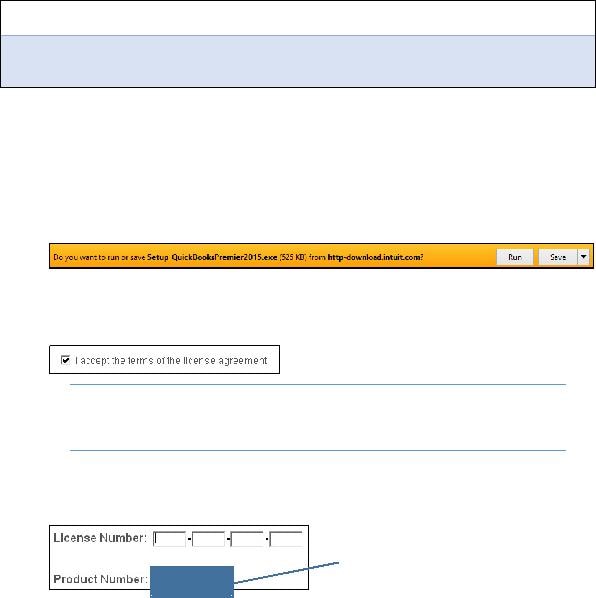
4.Choose the Run option in the download bar, and then choose Yes in the dialog box that appears.
Continue with the next step after the download completes.
5.Click Next in the wizard screen, and then click Next in the Intuit QuickBooks Installer window.
6.Click the checkbox to accept the terms of the license agreement; click Next.
Tip! If desired, use the Print link at the top‐right corner
of the window to print the License Agreement for your records.
7.Ensure that the Express (recommended) installation type is selected; click Next.
The Express installation will place QuickBooks in the default location on your computer.
8.Type your license number and product number in the provided boxes; click Next.
For QuickBooks 2014, use 602‐834.
For QuickBooks 2015, use 503‐153.
9.Click Install.
The installation can take time, so be patient!
10.Click Open QuickBooks in the screen that appears after the installation is complete.
11.If a notice regarding how QuickBooks uses your Internet connection appears, click OK.
The QuickBooks trial software is now installed on your computer.
12.Toggle to the Pro edition of the software, if necessary for your course.
Space Time Odyssey: Cosmos - A
The animation that follows—showing coastal cities drowning, farmlands turning to dust—is not alarmist. It is mathematical. It is logical. It is devastating. This is Cosmos at its most Sagan-esque: loving the planet enough to tell the hard truth. The series also boldly corrects and expands the original. While Sagan’s Cosmos was a product of the Cold War, A Space-Time Odyssey reflects the post-9/11, climate-change era. It includes an entire episode dedicated to the life of Hypatia of Alexandria—the pagan female philosopher murdered by a Christian mob—not as an anti-religious polemic, but as a warning about the fragility of knowledge when dogma replaces inquiry. The series does not hate faith; it fears the moment when faith silences observation.
The series opens not in a studio, but aboard the Ship of the Imagination , a fictional spacecraft capable of traveling beyond the speed of light, across the event horizons of black holes, and backward to the singularity of the Big Bang. This vessel is the show’s masterstroke. It is a narrative device that dissolves the boundaries between lecture and poetry, turning astrophysics into an emotional and visual experience. If the original Cosmos was a miracle of 1980s television—using nascent computer graphics and practical effects— A Space-Time Odyssey is a visual symphony rendered with 21st-century technology. The series, produced by Sagan’s original collaborators Ann Druyan (Sagan’s widow) and Steven Soter, alongside executive producer Seth MacFarlane, employs a breathtaking fusion of CGI, hand-drawn animation, and live-action cinematography. cosmos - a space time odyssey
The series does not end with an answer. It ends with an invitation. “That’s here,” Carl Sagan once said of Earth as a pale blue dot. “That’s home. That’s us.” A Space-Time Odyssey echoes this sentiment with a quieter, more urgent plea. Look at the darkness between the stars, it says. See the cold, empty, violent abyss. Now look at the warmth of your hand, the complexity of a flower, the love between a parent and child. All of that—the fragile, beautiful miracle of consciousness—exists because the universe spent 13.8 billion years becoming complex enough to know itself. It is devastating
In the winter of 1980, a mild-mannered astronomer named Carl Sagan sat before a simple backdrop of stars and, with poetic cadence, invited 500 million people across 60 countries to join him on a “personal voyage” through space and time. His vehicle was Cosmos: A Personal Voyage —a 13-part television series that became a global phenomenon, not because it promised answers, but because it dared to ask the biggest questions with humility and awe. While Sagan’s Cosmos was a product of the
The animation that follows—showing coastal cities drowning, farmlands turning to dust—is not alarmist. It is mathematical. It is logical. It is devastating. This is Cosmos at its most Sagan-esque: loving the planet enough to tell the hard truth. The series also boldly corrects and expands the original. While Sagan’s Cosmos was a product of the Cold War, A Space-Time Odyssey reflects the post-9/11, climate-change era. It includes an entire episode dedicated to the life of Hypatia of Alexandria—the pagan female philosopher murdered by a Christian mob—not as an anti-religious polemic, but as a warning about the fragility of knowledge when dogma replaces inquiry. The series does not hate faith; it fears the moment when faith silences observation.
The series opens not in a studio, but aboard the Ship of the Imagination , a fictional spacecraft capable of traveling beyond the speed of light, across the event horizons of black holes, and backward to the singularity of the Big Bang. This vessel is the show’s masterstroke. It is a narrative device that dissolves the boundaries between lecture and poetry, turning astrophysics into an emotional and visual experience. If the original Cosmos was a miracle of 1980s television—using nascent computer graphics and practical effects— A Space-Time Odyssey is a visual symphony rendered with 21st-century technology. The series, produced by Sagan’s original collaborators Ann Druyan (Sagan’s widow) and Steven Soter, alongside executive producer Seth MacFarlane, employs a breathtaking fusion of CGI, hand-drawn animation, and live-action cinematography.
The series does not end with an answer. It ends with an invitation. “That’s here,” Carl Sagan once said of Earth as a pale blue dot. “That’s home. That’s us.” A Space-Time Odyssey echoes this sentiment with a quieter, more urgent plea. Look at the darkness between the stars, it says. See the cold, empty, violent abyss. Now look at the warmth of your hand, the complexity of a flower, the love between a parent and child. All of that—the fragile, beautiful miracle of consciousness—exists because the universe spent 13.8 billion years becoming complex enough to know itself.
In the winter of 1980, a mild-mannered astronomer named Carl Sagan sat before a simple backdrop of stars and, with poetic cadence, invited 500 million people across 60 countries to join him on a “personal voyage” through space and time. His vehicle was Cosmos: A Personal Voyage —a 13-part television series that became a global phenomenon, not because it promised answers, but because it dared to ask the biggest questions with humility and awe.